Multi-ply asphalt assembly
Built-Up Roofing (BUR) in Dallas, TX
The oldest assembly still in regular commercial use, and the one with the most margin built into it. It also hides its problems better than anything else on a roof.
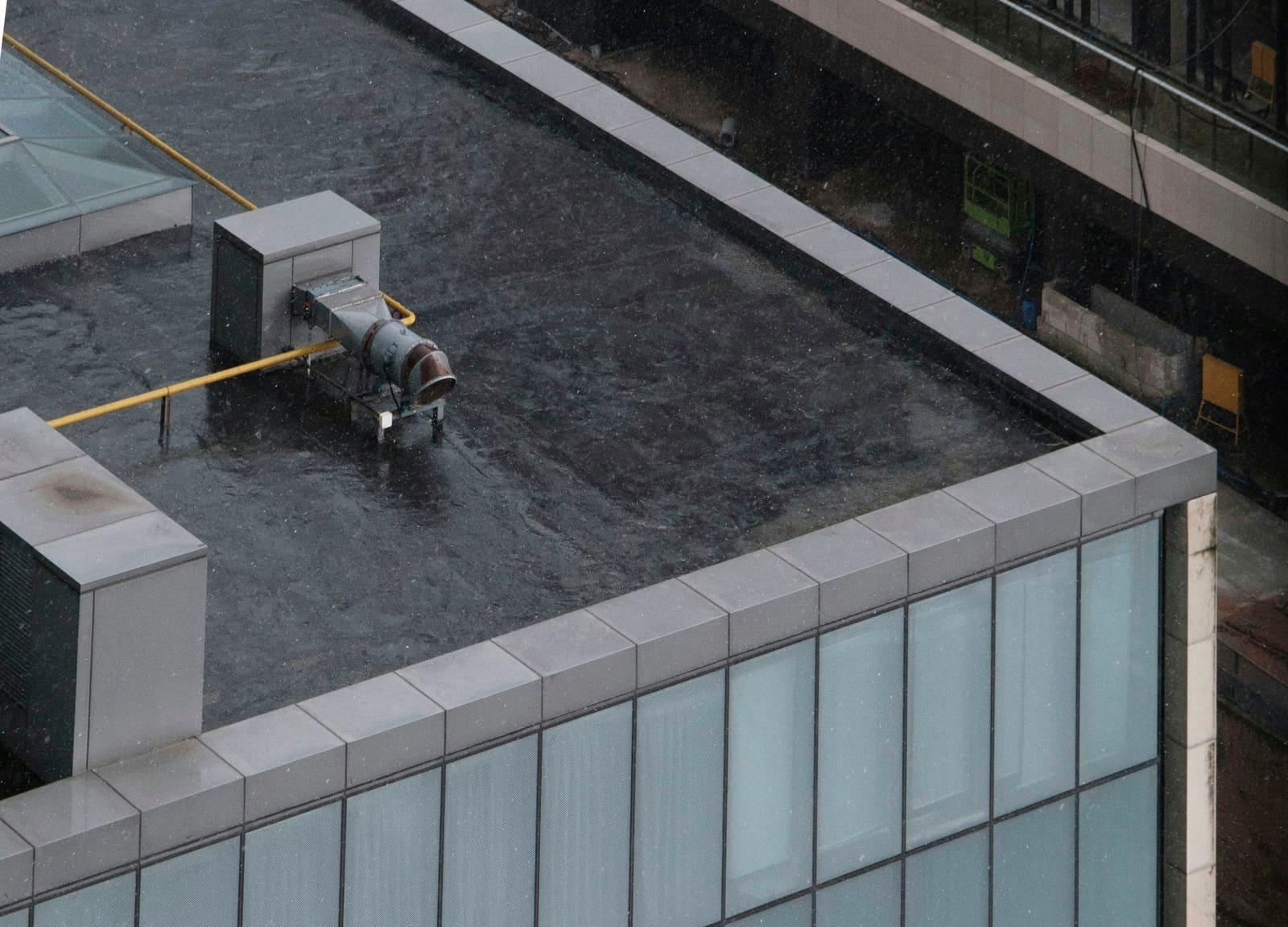
A dark asphalt surface takes the full solar load in summer, and the parapet edge is the first place to look when water gets behind it.
At a glance
- Service life
- 20 to 30 years
- Installation
- Felts laid in courses and mopped in hot bitumen, then surfaced.
- Typical fit
- Existing asphalt roofs on structures sized for the weight.
A roof assembled in layers on site
Built-up roofing is not a sheet you roll out. It is a membrane constructed in place. Felts, fiberglass on most modern work and organic on older buildings, go down in overlapping courses with hot bitumen mopped between each course. Three plies and four plies are the common counts, and each ply is a complete water barrier in its own right. Nothing else in commercial roofing carries that much redundancy inside the membrane.
The top gets a surfacing, because bitumen exposed to sunlight does not last. A flood coat of hot asphalt with aggregate broadcast into it is the traditional finish, and the stone does three jobs: it screens ultraviolet, it adds ballast against uplift, and it absorbs impact that would otherwise reach the felts. The alternative is a granulated cap sheet mopped over the plies, which gives up some of that impact resistance and buys back the ability to see the membrane.
Because the plies are laid separately, the quality of the finished roof is set by how consistently the bitumen went down. The target is a continuous film at a specified weight per square, hot enough to bond the moment the felt lands in it. Temperature gets read at the kettle and again at the point of application, because the asphalt cools on the way across the roof and cools faster on a cold or windy morning.
How a built-up roof gives up
Where the mopping ran light or the asphalt had already cooled, the felts never fully bonded and an interply void is left behind. Air trapped in that void expands every day the sun hits it, and the void grows into a blister. On a gravel roof that process is invisible until somebody brooms the stone back, and by then the blister may be a foot across with the upper plies separated from everything below them.
Ridging shows as long raised welts running in straight lines across the field. They follow insulation joints or the laps in the base ply, and they mean the assembly is moving where it ought to be still. Splits eventually open along those ridges, and they also open where the roof steps, where a deck deflects, and at the corners of curbs and skylight frames. A split here tends to produce a slow leak rather than a sudden one, because there are still plies under the one that opened.
Where the flood coat loses its stone, the exposed bitumen oxidizes and cracks into the pattern people call alligatoring. Aggregate migrates as well: wind and water push it off the high spots and pile it into the low ones, so the areas that most need protection lose it first. Flashings deserve separate attention, because the transition from a hot-applied membrane to metal at an edge or a pitch pan puts two materials with different expansion rates in contact and expects them to stay together.
Aggregate makes everything slower
The largest practical drawback is that you cannot see the roof. Under a flood coat and stone the membrane is hidden, so a survey means brooming or vacuuming the aggregate back across the areas of interest, and tracing a leak means doing that repeatedly while working uphill from the interior evidence. Work that takes an hour on an exposed membrane can take an afternoon here.
Test cuts do most of the diagnostic work. A square of the assembly comes out so the plies can be counted, the bond between them read, and the insulation below checked for moisture. That is the only reliable way to learn what is actually stacked on a building, and it is also why a proper condition report on an aggregate roof costs more than one on a smooth membrane.
Surfacing complicates the rest of the work too. Stone has to be cleared and kept out of drain sumps, loose gravel underfoot on any slope is a hazard, and any equipment set on the roof needs the aggregate removed and the area properly flashed rather than bedded into the flood coat. Vacuum trucks and gravel spreaders are specialty equipment, and their availability drives the schedule more than the roofing does.
When built-up is still the right answer
New built-up work is less common than it once was, and that has more to do with labor, kettles and schedule than with how the roof performs. Where it still makes sense is on a building that already has it, has dry insulation, and has a structure sized for the weight. Replacing in kind keeps the chemistry matched and sidesteps the compatibility problems that come from setting a different material over aged asphalt.
It also suits buildings where the roof takes abuse. Heavy foot traffic, dropped hardware and repeated hail all land on stone instead of on membrane, and a four-ply assembly under aggregate absorbs punishment that would open a thin sheet. Where an owner intends to hold a property for decades and wants the assembly with the most margin in it, this is that assembly.
Against that: the dead load, which an engineer should confirm before any recover; the odor and smoke from a kettle, which travels straight into rooftop air intakes if nobody plans for it; the installation time, which is longer than anything else in this comparison; and drainage, because a heavy assembly on a marginal deck deflects and the low spots it creates hold water. Slope gets corrected with tapered insulation before the first ply is mopped down, not afterward.
Fit
Redundancy you can rely on, weight you have to justify
Good fit
- Existing built-up roofs with dry insulation, where replacing in kind keeps the chemistry matched.
- Structures verified to carry felts, bitumen and a stone surfacing without deflecting.
- Roofs subjected to heavy foot traffic, dropped hardware and repeated impact.
- Owners holding a property long enough to value redundancy over installation speed.
- Perimeters and corners where ballast against uplift is genuinely useful.
Watch for
- Blisters concealed under aggregate, which only surface once the stone is broomed back.
- Ridging in straight lines across the field, tracking insulation joints or base ply laps.
- Bare, checked bitumen where the flood coat has shed its stone.
- Gravel washed off the high areas and heaped into the low ones and the drain sumps.
- Kettle placement against rooftop air intakes, which has to be settled before work starts.
- Added dead load on a deck that was never sized for a second heavy assembly.
Common questions
Is built-up roofing obsolete?
No, but it is specified less on new work. Kettles, crew size, install time and odor control all count against it when a single-ply roof can be closed in a fraction of the time. On buildings that already carry it and have dry insulation underneath, replacing or recovering in kind is frequently the most sensible option available.
How do you find a leak under gravel?
Slowly, and by elimination. The interior evidence gets marked, then the aggregate is broomed or vacuumed back across everything uphill of that point so the flood coat can be examined. Suspect areas get test cuts so the plies and the insulation below can be read. It is more labor than the same search on an exposed membrane, and pricing that reflects the surfacing is honest pricing.
Can the gravel come off and the roof be coated instead?
Occasionally, and only after real preparation. The aggregate has to be vacuumed off, the remaining embedded stone addressed, the surface cleaned, and the felts confirmed sound and dry by core. Blisters, splits and alligatored areas are repaired as roofing first. Where cores come back wet, coating is the wrong direction and the discussion moves to replacement.
How many plies should a built-up roof have?
Three and four ply assemblies are both common, with four giving more redundancy and more weight. What matters more than the count is whether the bitumen went down at the specified weight and at the right temperature between every course. A four-ply roof mopped badly is worse than a three-ply roof mopped correctly.
Will our building carry the weight?
That question goes to a structural engineer, not to a roofer, and it gets asked before a recover is priced rather than after. A gravel-surfaced built-up assembly is the heaviest thing in this comparison. Adding one over an existing roof adds dead load the frame may never have been designed for, and the answer varies by building even within the same development.