Two-ply asphalt membrane
Modified Bitumen Roofing in Dallas, TX
Thick, walkable, and forgiving around curbs and pipes. This is the assembly to reach for when a roof has more detail on it than open field.
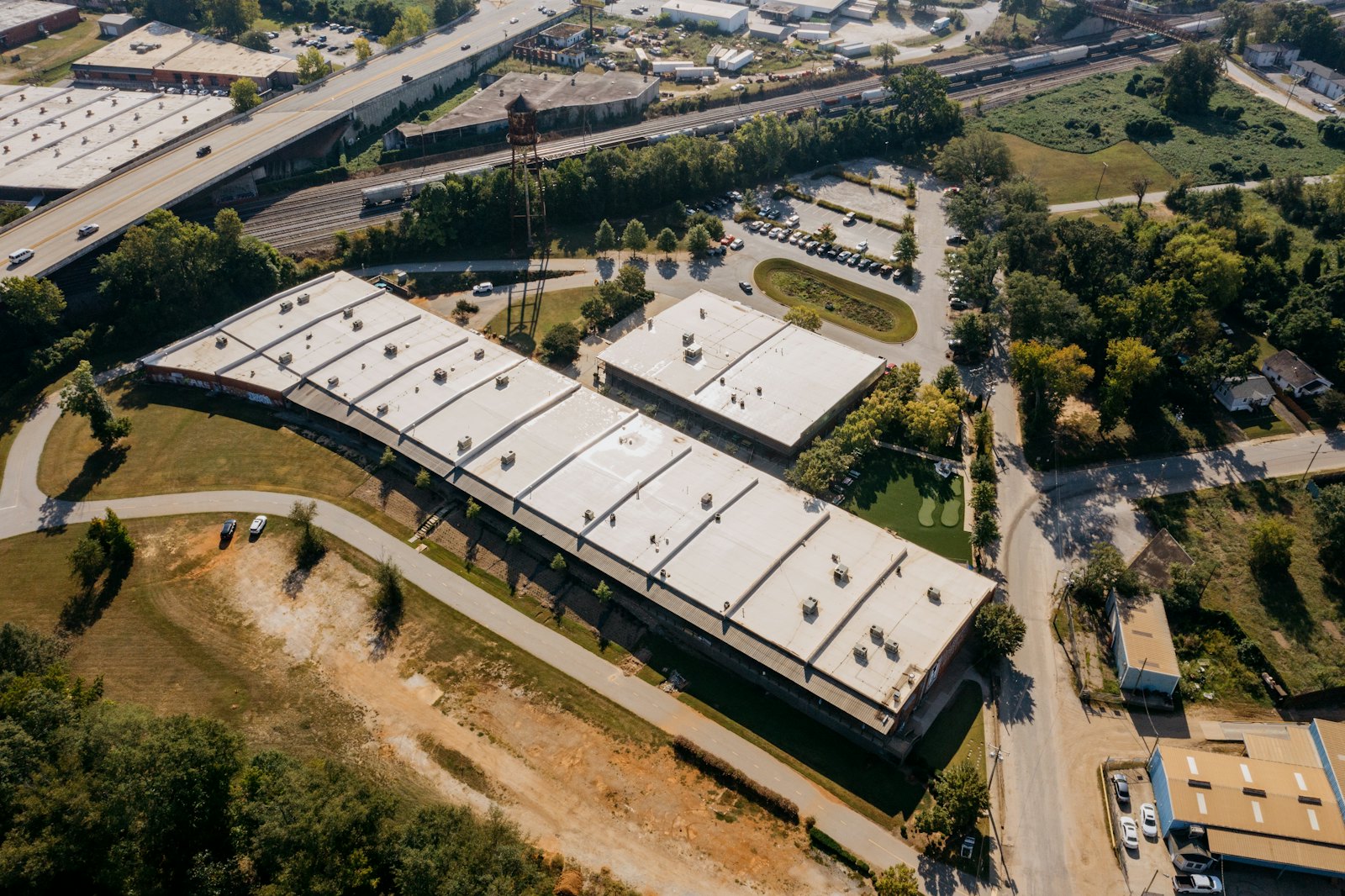
A flat roof this size gets walked and serviced along defined routes, and mechanical curbs like these are usually where the first look starts.
At a glance
- Service life
- 15 to 20 years
- Installation
- Torch, hot mop, cold adhesive, or self-adhered off a release liner.
- Typical fit
- Crowded roofs and buildings with regular service traffic.
SBS, APP, and what reinforces the sheet
Modified bitumen is asphalt with a polymer blended into it, and which polymer went in changes both how the sheet behaves and how it can be installed. SBS is a rubber modifier. It leaves the sheet elastic, so it stretches and returns as the building moves and it stays workable when the temperature drops. APP is a plastic modifier. It raises the softening point and gives a harder, more ultraviolet-tolerant surface, at the cost of the elongation SBS provides.
The practical difference is application. An SBS sheet can be mopped in hot asphalt, set in cold adhesive, self-adhered from a release liner, or torched. An APP sheet is effectively torch-applied only, because the compound has to be melted to bond at all. On a building where open flame is a problem, that narrows the field before anything else gets considered.
The polymer is only half of what gets specified. Every sheet is built around a reinforcement mat, and the choice there is between polyester and fiberglass. Polyester carries far higher elongation and holds up better to puncture and to repeated flexing. Fiberglass holds its dimensions, resists shrinkage, and lies flatter across the field. Plenty of assemblies use both, with a fiberglass base ply for stability under a polyester cap sheet that has to absorb movement and foot traffic.
Both arrive as a granulated cap sheet over a smooth base sheet. The granules are the ultraviolet screen. Everything under them is asphalt, and asphalt left in direct sun turns brittle within a few seasons, so granule retention deserves more attention than it usually gets on a maintenance visit.
Two plies, and how they get bonded
A standard assembly is a base sheet and a cap sheet, with the cap laps offset from the base laps so no joint runs through both layers. That offset is the redundancy. Water that works past a cap lap lands on continuous base sheet instead of on insulation.
Hot asphalt from a kettle is the traditional method, and it produces a strong bond when the asphalt reaches the roll inside its temperature window. It also produces odor that finds building air intakes, which is why kettles get sited downwind and intakes get shut down or filtered for the duration. Torching bonds by melting the underside of the roll as it unrolls, and it requires a fire watch that stays on the roof for hours after the crew leaves, plus real care anywhere the sheet meets wood blocking, a hollow parapet, or an old organic felt roof.
Cold adhesive and self-adhered sheets exist because of those two problems. Cold-applied systems use a solvent or water-based adhesive spread with a squeegee. Self-adhered sheets bond off a release liner under roller pressure and warmth. Both are slower, both are fussier about ambient temperature, and both let you re-roof an occupied medical building without a kettle in the parking lot or a flame near a return air duct.
How a modified bitumen roof lets water in
Laps come apart first, and they come apart because the bond was never fully made. A torched lap is right when a small bead of melted compound squeezes out along the edge as the roll passes. No bead means the sheet landed on compound that had not reached temperature, and that joint is holding by friction. A mopped lap fails the same way when the asphalt cooled before the roll was walked in. Both look finished from a standing position.
Blisters grow between plies wherever air or moisture was trapped at install. They expand as the roof heats, contract overnight, and the flexing works the surrounding bond loose, so a blister is larger every year. A small firm one can be left alone and measured on each visit. One that has gone soft, or one sitting in a walking route, gets cut open, dried out, and rebuilt with new plies before somebody puts a foot through it.
The cap sheet ages from the top down. Granules wash toward the drains, hail knocks them loose, and foot traffic grinds them into the compound. Where the surface goes bare, the asphalt oxidizes and checks into a fine crazing pattern. Ridging tells a different story: a long raised line running across the field usually sits over a base sheet lap or an insulation joint that is moving under it. Splits open along those ridges, at changes of plane, and wherever a deck moves more than the sheet can absorb, which is the failure SBS resists better than APP.
The roofs this system suits
This is the assembly to choose when a roof is crowded. Small and medium roofs with a high ratio of detail to open field are where a torched or mopped sheet earns its money, because flashing a curb, a pipe, a corner or an awkward transition in two-ply asphalt is ordinary work that does not depend on a hot-air weld holding at an inside corner.
It is also the one to choose when people are going to walk on it. A granulated cap over a base sheet takes dropped tools, dragged equipment and daily service traffic considerably better than a thin thermoplastic sheet does. Grocery refrigeration racks, restaurant kitchens and dense mechanical decks all benefit from that thickness.
The tradeoffs are real. A dark cap absorbs heat rather than reflecting it, so a reflective cap sheet or a coating gets specified when the cooling load matters. The system weighs more than single-ply. Torch work has to be planned around whatever is combustible. And the 15 to 20 years quoted for this assembly assumes the cap keeps its granules, which in practice means keeping traffic on pads and washing grease off the surface before it works into the compound.
Fit
A thick, walkable membrane for roofs full of detail
Good fit
- Roofs crowded with curbs, pipes, drains and odd transitions, where detail outnumbers open field.
- Buildings with regular rooftop service traffic that would puncture a thinner sheet.
- Structures able to carry the added weight of a two-ply asphalt assembly.
- Re-roofs over existing asphalt systems, where the chemistry already matches what is there.
- Occupied buildings, using self-adhered or cold-applied sheets to avoid flame and kettle odor.
Watch for
- Laps with no bleed-out along the edge, meaning the compound never reached bonding temperature.
- Blisters between plies, which enlarge every summer and eventually go soft underfoot.
- Bare patches where granules have washed away and the asphalt beneath is checking.
- Fire watch on any torched job, kept on the roof well after the crew has packed up.
- A dark cap sheet on a building already struggling with its summer cooling load.
- Ridges running across the field over base sheet laps or insulation joints that are moving.
Common questions
Is torch work safe on an occupied building?
It can be done safely and it is not always the right call. Open flame near hollow parapets, wood blocking, old organic felts or fresh insulation demands a fire watch that remains on the roof after work stops, plus extinguishers staged at the work face and a plan for every combustible detail. Where the building or the tenant makes that uncomfortable, self-adhered or cold-applied sheets do the same job without a flame.
What does the difference between SBS and APP mean for my building?
SBS stretches and recovers, which suits a structure that moves, a deck with expansion joints, or a roof that sees a wide temperature swing. APP is harder and holds up to sunlight slightly better, but it has to be torched. If flame is off the table, you are choosing SBS by default, and on most buildings around here SBS is the sheet that gets specified anyway.
Can modified bitumen go over the roof we already have?
Sometimes. It depends on how many coverings are already stacked up, whether the insulation under them is dry, and whether the existing surface is flat and sound enough to build on. Cores answer all three. A gravel-surfaced roof usually needs the aggregate removed or a separation layer before anything new is bonded to it.
Does this roof have to be black?
No. Cap sheets are made with light-colored granules, and a reflective coating can be applied over a standard cap once it has cured and been cleaned. Either option raises reflectivity substantially. Both add cost, and the coated version adds a maintenance item, so the decision usually comes down to how much conditioned space sits directly under that roof.
How long does modified bitumen last here?
Figure 15 to 20 years on a roof that drains, gets inspected, and keeps its granules. The heat load in this region is the main thing pulling those numbers down, and standing water is the fastest way to reach the bottom of the range. Roofs that outlast it are almost always roofs where somebody kept the drains clear and the traffic on pads.