Post-event inspection and documentation
Hail Damage Commercial Roof Repair in Dallas, TX
Hail rarely punches through a commercial roof. It bruises the membrane and fractures what is under the surface, and the roof leaks about three years later.
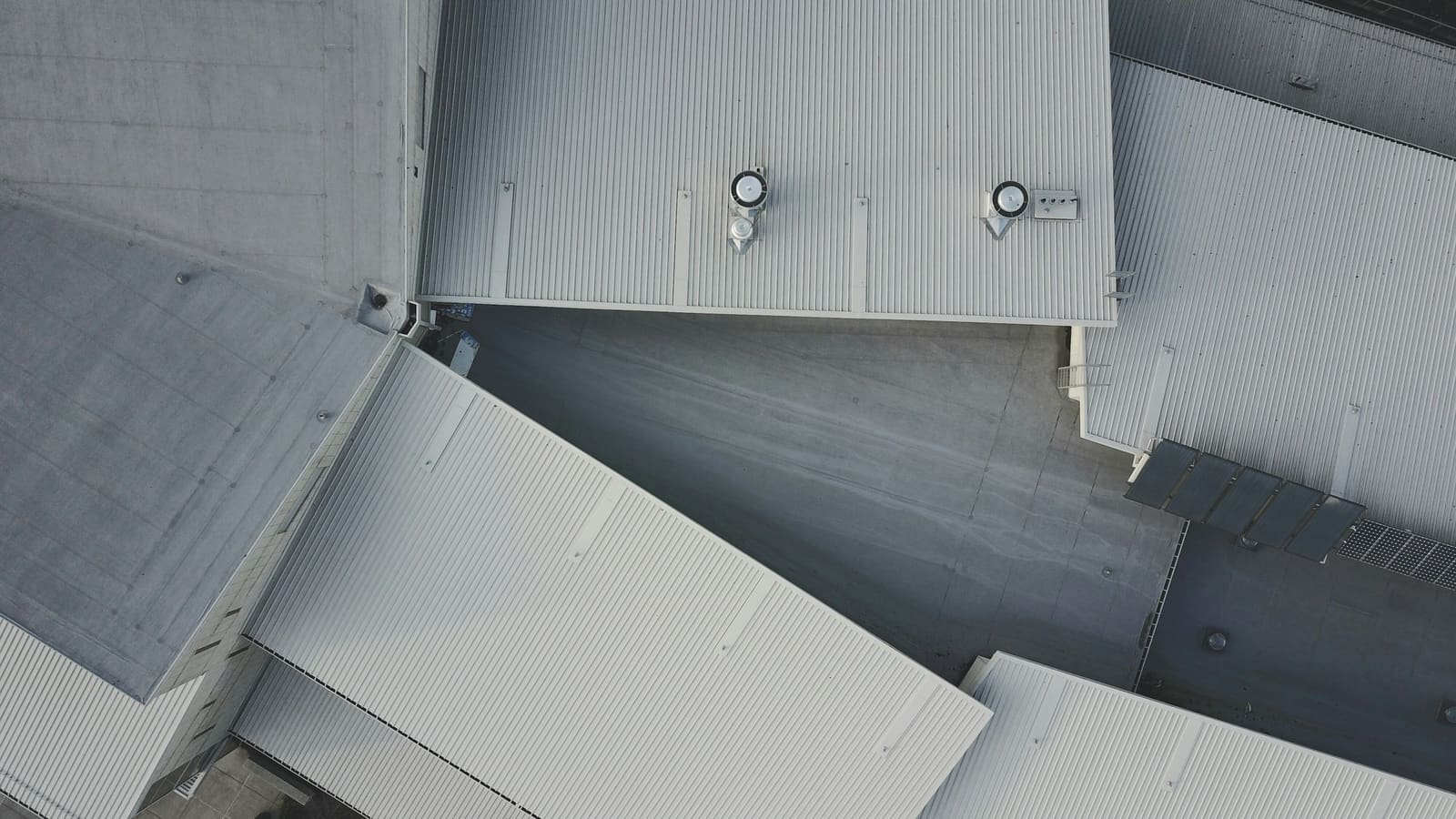
A field this size gets surveyed in marked test squares, not by walking until something looks wrong.
What hail actually does to each membrane
On gravel-surfaced built-up roofing, stones displace the aggregate and drive into the felts beneath. From above the roof looks like a roof. Broom the aggregate away from a suspect spot and the fractured plies are visible, and that fracture is a path for water the day the surfacing finally shifts.
On modified bitumen, impacts knock granules off the cap sheet and can fracture the reinforcing mat without opening the surface. Loss of granules alone removes UV protection and accelerates aging. Mat fracture shows on the underside of a test cut, which is the only place it shows at all.
On TPO and PVC, the sheet is rarely punctured outright. What fails first is the reinforcing scrim inside it, and where the membrane sits directly on something unyielding, a bare deck or an old roof surface or a fastener plate, it has less room to flex and the scrim fractures at lower impact energy. Those breaks frequently appear as star-shaped cracking on the underside of the sheet while the top face still looks fine.
On sprayed polyurethane foam, hail crushes cells under an intact coating. On metal, panels and flashings dent, and the parts to examine are the soft components: vents, gutters, ridge caps, and equipment housings. Coated roofs chip at the impact and expose whatever is under the coating.
Mapping impact density across the field
Walking a roof until something looks damaged is not an inspection, it is a stroll. A survey lays out marked test squares, commonly ten feet by ten feet, distributed across the field and across each elevation and each roof level, then counts impacts within each square.
Density and distribution both carry information. Hail arrives with wind behind it, so damage concentrates on the elevations facing the storm and thins on the lee side. A pattern consistent with that tells a very different story than scattered marks spread evenly everywhere, which usually indicates mechanical damage from foot traffic or dropped tools rather than weather.
Soft metals corroborate. Gutter aprons, vent hoods, roof jacks, condenser fins, and equipment housings dent at impact energies well below what damages a membrane, so their condition sets a floor under the story the field is telling. Every square gets chalked, scaled with a reference object, and photographed before anything is touched.
Test cuts show what the surface hides
A test cut removes a section of membrane from a marked square so the underside and the top of the insulation can be examined. This is the only method that reveals scrim fracture, mat separation, felt damage under aggregate, and crushed insulation facer beneath an impact that looks superficial from above.
Cuts are placed to answer specific questions: one in the highest density square, one in a moderate square, and one in an area with no visible impacts to serve as a control. Without the control there is nothing to compare against and the findings are just assertions.
Every cut is patched before the crew leaves the roof, using material compatible with the assembly, and each patch location is recorded on the plan. Nobody should leave a roof open to document that it was damaged.
Documenting a loss
What comes out of the inspection is a condition report: the date of loss, the surveyed elevations and levels, the test square locations marked on a roof plan, impact counts per square, photographs with a scale reference, photographs of the test cuts from both faces, the condition of the soft metals, and a plain description of what was found in each area.
That report exists to describe the roof accurately. We are roofers, not adjusters or public adjusters, and we do not negotiate with carriers or represent you in a claim. What we can do is document conditions, meet an adjuster on the roof and walk the same squares, and provide a repair or replacement scope with quantities.
Nobody can tell you whether a claim will be approved, and any contractor who does is telling you something they cannot know. Coverage depends on your policy language, your deductible, the date of loss, and the adjuster reading the same roof. Our part is making sure the evidence is complete and accurate on the day it is gathered, because it degrades from that point forward.
Wind damage travels with the hail
The storms that drop hail here bring straight-line wind with them, and wind failures look nothing like impact damage. Edge metal lifts at the fasteners. Coping joints open. A mechanically attached membrane billows and stretches, permanently deforming the sheet between rows of plates even where nothing tore.
Ballasted roofs lose stone from the perimeter and corners, which leaves those exact zones exposed for the next event. Loose or displaced rooftop equipment tears membrane as it moves. All of it belongs in the same report as the hail findings, documented separately because the failure modes are different and are evaluated differently.
Time matters more than most owners expect. Chalk marks weather off, granules wash into drains, dents oxidize, and interior evidence gets painted over. Reporting windows in most policies also run from the date of loss, so the survey date and the storm date should sit close together.
Turning the findings into a repair or replacement scope
Once the report is finished, the conditions in it convert to quantified work. Isolated punctures, split laps and torn flashings on an assembly that reads sound everywhere else are spot repair: each damaged area is cut out to sound material, the insulation underneath is checked and replaced where it is wet or crushed, and new membrane goes in with the terminations that detail requires. Those get counted location by location off the marked plan instead of estimated as a percentage of the field.
Widespread bruising points the other way, and it does so even on a roof that is still keeping water out. Fractured scrim, separated reinforcing mat and crushed insulation facer cannot be repaired in place, and they do not hold steady either. An assembly in that condition has given up service life it will not recover, so the relevant question is not whether it leaks this month but how many seasons the weakened areas can be expected to last before they open. When test cuts show that pattern across the field, full replacement is the scope that matches the roof.
Between those two sits the common case where one section of a roof took the storm and the rest did not. That gets sectioned: the affected area is replaced out to a logical break such as a parapet, an expansion joint, or a change in roof level, and the remainder stays under scheduled maintenance until it earns replacement on its own condition. Interim work comes first either way, so open punctures are closed before the larger scope is scheduled. Sequencing then follows the same rules as any other tear-off, sized so each area closes watertight the day it is opened.
The scope is written off the condition of the assembly, not off the size of a settlement. If less money arrives than the roof needs, the scope does not shrink to fit it. It stays as written, and what to fund and in what order becomes a decision you make with real quantities in front of you.
Test squares
Ten by ten foot squares chalked across each elevation and roof level, with impacts counted and photographed inside each one.
Soft-metal check
Vents, gutters, jacks, condenser fins and equipment housings dent at lower energy than membrane fails, which anchors the finding.
Core and test cuts
Membrane sections removed and read from both faces, including a control cut in an undamaged area, then patched before we leave.
Wind versus hail
Lifted edge metal, opened coping joints, billowed field sheets and displaced ballast documented separately from impact damage.
Interim repairs
Punctures and open laps closed right away so the roof is not taking on water while the claim question gets sorted out.
Written condition report
Date of loss, marked roof plan, scaled photographs, impact counts, and a repair or replacement scope with quantities.
Common questions
How soon after a storm should the roof be inspected?
As soon as it is safe to get on it. Evidence degrades: chalk washes away, displaced granules move to the drains, dents oxidize and blend in, and any interior water marks get cleaned up. An inspection within days produces a far stronger record than one done months later, and policies commonly have reporting requirements tied to the date of loss.
Can hail damage exist if the roof is not leaking?
That is the usual situation. Impact damage on a commercial membrane is generally not a hole, it is a bruise, a fracture in the reinforcement, or crushed insulation under an intact surface. The assembly keeps water out for a while and then fails in those weakened spots. A roof with no active leak can still have taken damage that shortens its remaining life by years.
Do you handle the insurance claim for us?
No. We inspect the roof, document the conditions, and provide a repair or replacement scope with quantities. We can meet your adjuster on the roof and walk the same test squares so both sides are looking at identical evidence. We do not adjust claims, negotiate with carriers, or act as your representative, and we cannot tell you what a carrier will decide.
What is a test square?
A marked area, commonly ten feet by ten feet, laid out in a set location on the roof so impacts inside it can be counted and photographed. Several squares distributed across the field and across each elevation turn scattered observations into a density pattern that can be compared, reviewed by another party, and checked against the storm direction.
Is a hail-damaged roof always a replacement?
No. Isolated impacts on a sound assembly are repairable, and localized repairs are often the right call. Widespread fracturing across the field, or impact damage combined with insulation already holding water, moves the answer toward replacement. Test cuts and cores are what settle it, not the count of dents on a vent hood.